
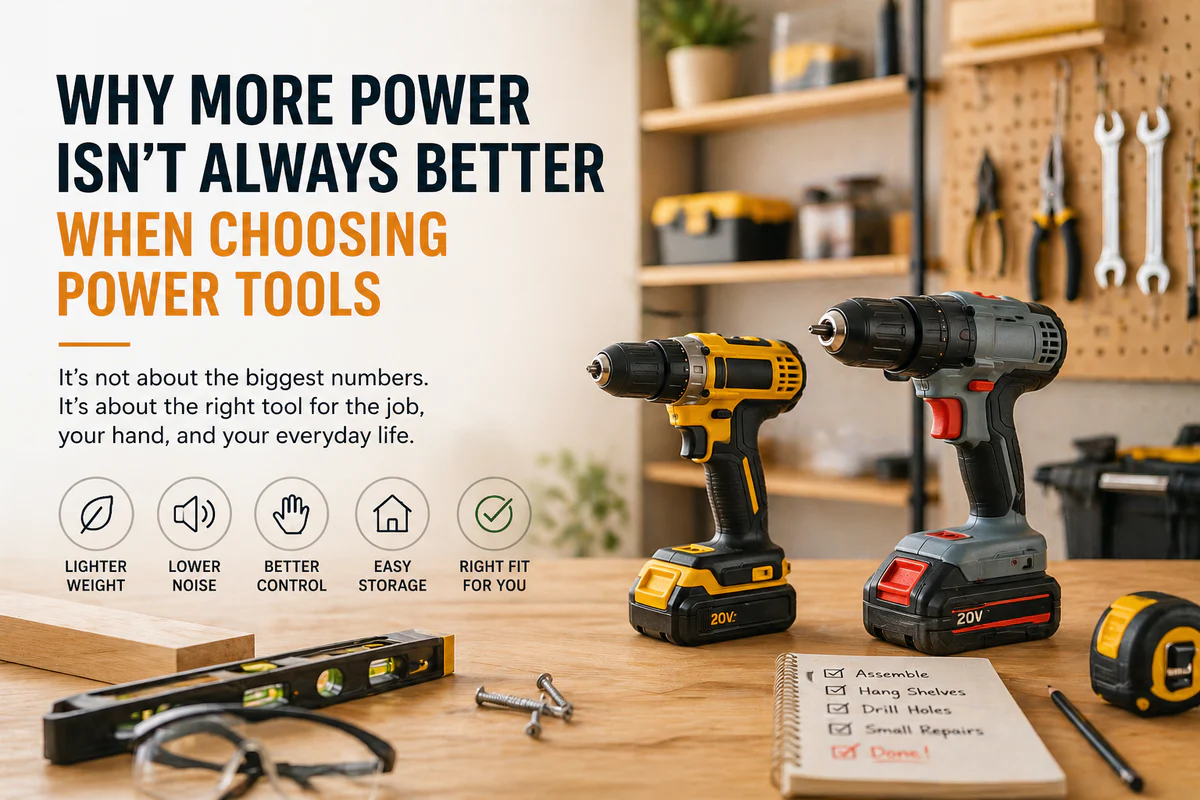

Why More Power Isn’t Always Better When Choosing Power Tools
April 28, 2026

When shopping for power tools, one factor tends to stand out above all others: power.
Higher wattage, higher voltage, bigger numbers—they all suggest stronger performance. It’s easy to assume that more power will automatically deliver better results.
But for everyday users, this belief often leads to a mismatch: tools that look impressive on paper but feel inconvenient or overwhelming in real use.
Why Specifications Feel So Convincing
When you’re unfamiliar with how a tool actually performs, technical specs offer something reassuring. Numbers make comparison simple and objective.
Power ratings, in particular, seem to promise efficiency, durability, and speed. They create the impression that a tool can handle anything you throw at it.
However, specifications reflect potential—not the day-to-day experience of using the tool.
And in most homes, that difference matters more than people expect.
Where Specs and Reality Diverge
In everyday situations, power tools are rarely pushed to their limits.
Typical tasks include:
- Assembling furniture
- Drilling into drywall or soft wood
- Tightening screws or bolts
- Making small adjustments around the house
These activities don’t demand maximum power—they require control and ease of use.
A tool that’s too heavy, too loud, or difficult to handle can turn simple jobs into frustrating ones, regardless of how powerful it is.
What Actually Makes a Tool Enjoyable to Use
For most people, comfort and usability play a far bigger role than raw performance.
- Weight and balance
A well-balanced tool improves accuracy and reduces fatigue, especially during longer or overhead tasks. - Ergonomics and grip
A comfortable, secure grip helps users feel in control, making even unfamiliar tasks more manageable. - Noise and vibration
Excessive noise and shaking don’t just irritate—they discourage regular use. - Storage and practicality
Bulky tools that are hard to store often end up forgotten, no matter how capable they are. - Fit for purpose
A tool is only as useful as its relevance to your actual needs. Too much capability can be just as limiting as too little.
The Reality of Long-Term Use
Many tools aren’t used daily—they’re picked up occasionally for small fixes.
In these cases, ease of use becomes far more important than peak performance. A tool that feels approachable is more likely to be used regularly, while one that feels excessive may sit unused.
Over time, overly powerful tools can feel less like assets and more like burdens.
What People Often Regret
Common frustrations tend to sound familiar:
- “It’s heavier than I expected.”
- “It’s too loud for quick jobs.”
- “I didn’t need something this powerful.”
Interestingly, it’s rare to hear someone complain that their tool wasn’t powerful enough.
These experiences point to a gap between expectation and reality—not a lack of capability.
Choosing What Actually Fits Your Life
You don’t need technical expertise to choose the right tool—just a clear understanding of your habits.
Ask yourself:
- How often will I realistically use this?
- Do I have space to store it easily?
- Will I feel comfortable using it for small, quick tasks?
A tool that feels easy to pick up is far more valuable than one that feels intimidating.
Redefining What “Better” Really Means
In everyday life, “better” doesn’t mean more powerful.
It means more practical.
More comfortable.
More intuitive.
When a tool fits naturally into your routine, its usefulness goes far beyond its specifications.
And sometimes, choosing less power leads to a better overall experience.
Leave a Reply