

From Intimidating to Essential: How Power Tools Became Beginner-Friendly
April 28, 2026

For a long time, power tools were closely associated with construction sites, workshops, and skilled tradespeople. They were seen as loud, heavy, and complicated—tools best left to experts. Naturally, many homeowners and renters assumed they had little reason, or ability, to use them.
That assumption is starting to fade.
Today, power tools are steadily finding their way into everyday homes, used not by professionals, but by regular people handling routine tasks on their own.
Understanding the Hesitation
The reluctance around power tools often comes from unfamiliarity.
Some people grew up in households where repairs were always outsourced. Others may have only encountered older tools that felt bulky, noisy, and difficult to control. These experiences shaped a simple belief: power tools are complex, risky, and meant for professionals.
But modern tools tell a different story.
They are increasingly designed with beginners in mind—simpler, safer, and far more approachable than before.
Who’s Using Them Now?
In today’s homes, a wide range of people are picking up power tools for practical, everyday use:
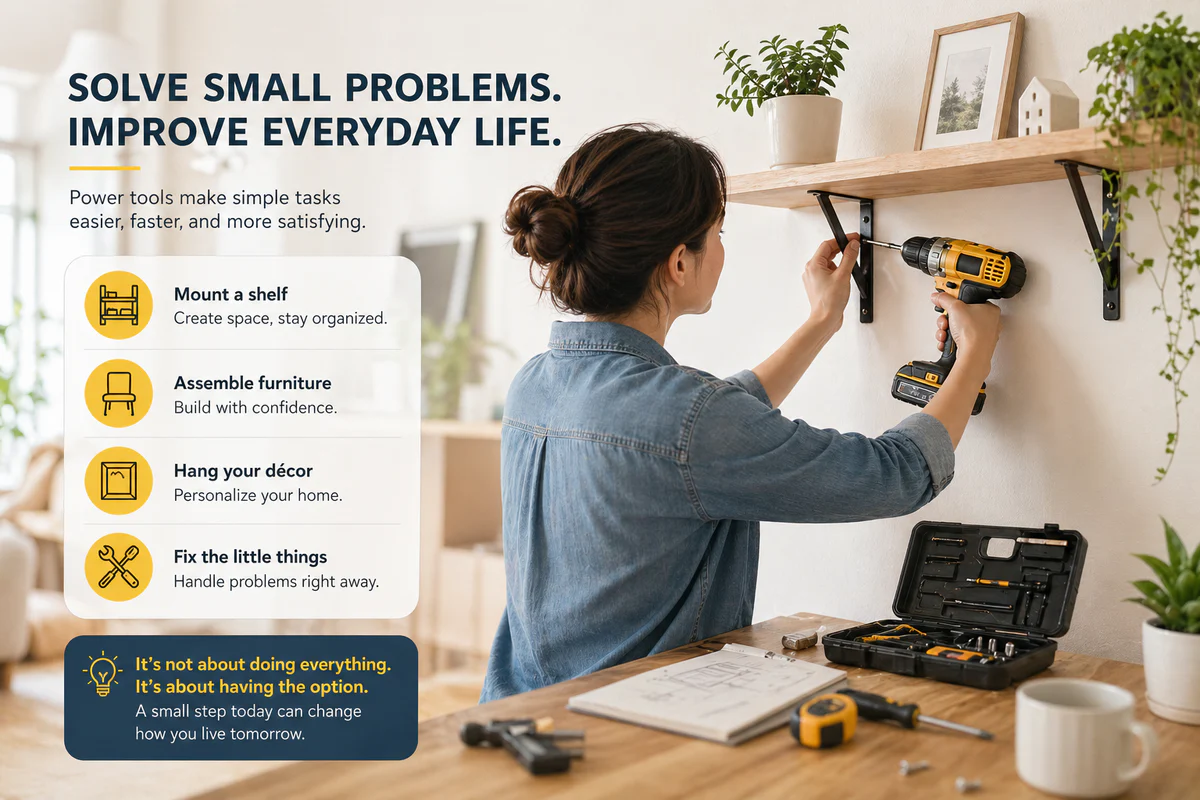
- Renters installing shelves, curtains, or lighting
- New homeowners assembling furniture or making small improvements
- Parents securing fixtures and making spaces safer for children
- Hobbyists working on small creative projects
These aren’t trained specialists. They’re individuals choosing to handle small tasks themselves instead of relying on outside help.
The goal isn’t expertise—it’s convenience and independence.
Designed for Everyday Use
One of the biggest reasons behind this shift is how much power tools have evolved.
Modern designs focus on usability:
- Straightforward controls
- Lighter, more manageable builds
- Comfortable, ergonomic grips
- Integrated safety features
Instead of demanding strength or technical skill, they support steady, controlled use. Clear instructions and intuitive operation make it easier for beginners to get started without feeling overwhelmed.
For many, the first successful use changes everything—confidence replaces uncertainty, and hesitation quickly fades.
Breaking Common Misconceptions
Even with these improvements, a few common beliefs still hold people back:
- “I’m not a technical person.”
Most household fixes involve simple actions like drilling or tightening—not advanced knowledge. - “I might damage something.”
Careful use of a power tool often leads to more precise results than struggling with manual tools. - “I won’t use it often.”
In reality, small repairs come up more frequently than expected.
From Uncertainty to Confidence
The first experience with a power tool is rarely perfect. There may be small mistakes or moments of hesitation. But with each task, confidence builds.
This shift—from avoiding problems to addressing them—can noticeably change daily life.
Loose screws get fixed right away. Unstable furniture gets adjusted. Small annoyances no longer linger. Over time, people begin shaping their spaces to better suit their needs.
It’s not about becoming highly skilled. It’s about feeling capable.
Rethinking Practical Skills
In the past, basic repair skills were often learned informally at home or within communities. As lifestyles became more specialized, many of these everyday abilities faded.
Power tools help close that gap.
They don’t eliminate the need to learn, but they lower the barrier to getting started. By making tasks easier to execute, they encourage people to learn through experience—often beginning with something small.
A Different Way of Living at Home
When people feel able to fix and adjust their surroundings, their relationship with home naturally changes.
Spaces become more adaptable. Furniture feels less permanent. Problems feel manageable rather than frustrating.
Power tools, once seen as professional equipment, are gradually becoming everyday essentials—helping people take a more active role in shaping the spaces they live in.
Leave a Reply